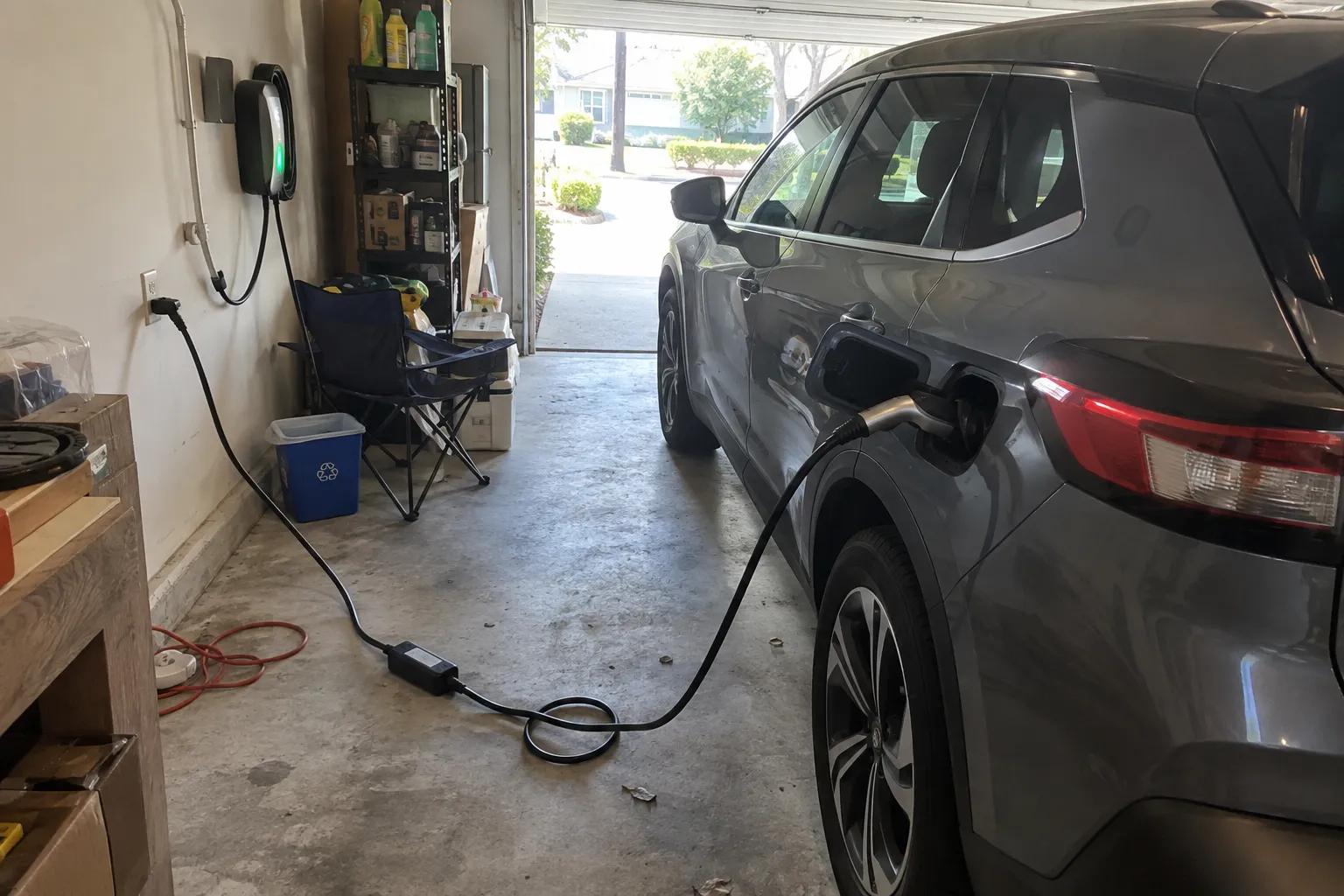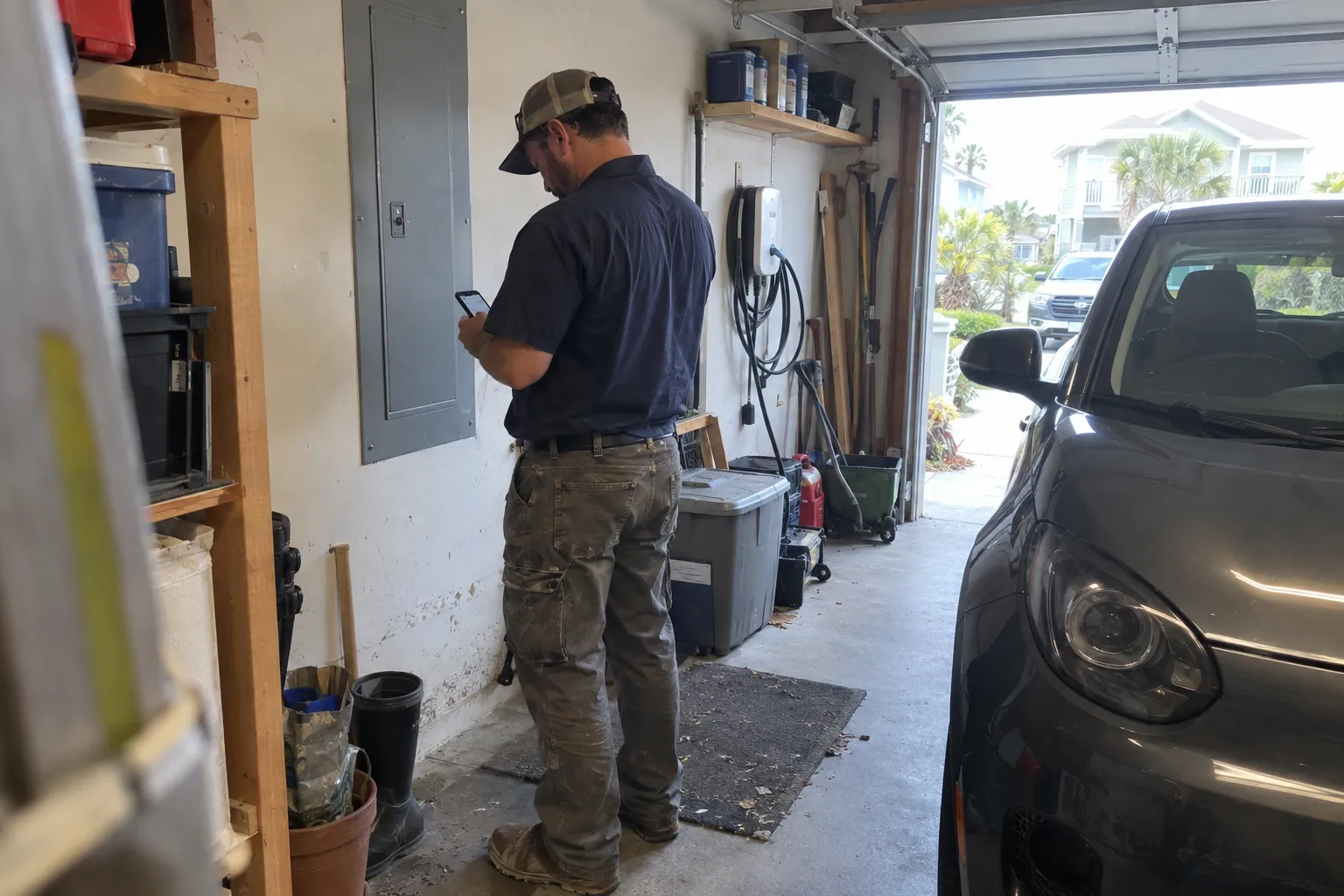

The number printed on your main breaker is not a complete yes-or-no answer to whether your home can handle a Level 2 EV charger. The EPA notes that even a 100-amp service can often support Level 2 charging, depending on the home’s other electrical loads, while a 200-amp service with available breaker space is more likely to have room. The responsible answer comes from reviewing the service, calculated load, charger current, circuit route, equipment, and property together. Coastal Comfort Electric’s EV charger installation service gives Wilmington-area homeowners a place to request that property-specific review.
That is good news for homeowners worried that buying an EV automatically means buying a new electrical panel. Some homes need an upgrade. Many do not. Others can use a lower charging rate or a load-management approach—but only after the actual electrical conditions are understood.
Residential focus: This guide addresses single-family home charging. Commercial and multifamily projects have additional considerations such as multiple ports, accessibility, parking layouts, protective equipment, networking, payment systems, and larger service loads. Coastal Comfort Electric handles those inquiries through its commercial EV charger installation service.
What Electrical Requirements Does A Level 2 EV Charger Have?
Level 2 charging generally uses 208- or 240-volt power supplied by a dedicated circuit. The exact circuit depends on the charging equipment and its configured output.
EV charging is treated as a continuous electrical load. The EPA’s current home-charging guidance provides a common example: a charger delivering 40 amps requires a dedicated 50-amp circuit. A charger configured at a lower current may use a smaller properly designed circuit; higher-output equipment has different requirements and may need to be hardwired.
The charger label alone does not define the whole installation. The work may also involve:
- the charger’s permitted or configured output
- breaker and conductor sizing
- panel and service capacity
- grounding and required protection
- receptacle or hardwired connection requirements
- conduit, cable, and routing method
- indoor or outdoor equipment ratings
- disconnecting and labeling requirements where applicable
- permits and inspection
Manufacturer instructions and the electrical code applicable to the project are part of the installation—not optional reading after the work is complete.
What Does An Electrician Check Before EV Charger Installation?
1. Main electrical service rating
The service rating establishes an important boundary, but it does not show how heavily the home is already loaded. A 200-amp all-electric home with multiple large loads may have less available capacity than expected. A 100-amp home with gas appliances and modest electrical demand may have more flexibility than the number suggests.
2. The home’s calculated electrical load
A load calculation considers the home and its significant existing loads instead of simply adding up breaker numbers. HVAC equipment, electric heat, water heating, cooking appliances, clothes drying, pools, hot tubs, workshops, and other equipment can materially affect the result.
This is why two neighboring homes with identical-looking panels may receive different EV-charging recommendations.
3. Physical breaker space and panel condition
Level 2 charging normally needs a two-pole breaker. The electrician checks whether the panel has the correct physical space, whether the equipment is approved for the proposed breaker, and whether its condition supports adding another sustained load.
Adding a subpanel can create more circuit positions, but it does not increase the electrical service capacity by itself. That distinction prevents a common misunderstanding: more spaces do not automatically mean more available power.
4. The charging rate you actually need
The largest available charger is not automatically the best fit. A homeowner who drives 30 miles most days may be well served by a lower-current Level 2 setup, while a high-mileage household or two-EV home may benefit from a different plan.
The electrician should know the vehicle, daily mileage, parking time, and future plans before treating maximum amperage as a requirement.
5. Circuit distance and installation route
The distance from the panel to the parking space affects conductor length, conduit, access, voltage drop considerations, labor, and restoration. A charger on the garage wall beside the panel is a different project from one across a finished home, detached garage, driveway, or landscaped area.
Attic access, crawlspace access, masonry, finished ceilings, trenching, flood exposure, and physical protection can all shape the installation.
6. Charger location and equipment rating
The location needs to work with the vehicle’s charging-port position and cable length without creating a trip or driving hazard. Outdoor installations require equipment and materials suitable for weather exposure. Around coastal North Carolina, placement should also account for drainage, sun, wind-driven rain, salt air, landscaping, and potential vehicle impact.
7. Permitting and inspection requirements
New Hanover County’s dedicated EV-charging guidance says most chargers require an electrical permit. Its current residential checklist may call for a site sketch, load or circuit information, equipment documentation, the proposed charger location, and any panel-upgrade scope. Concealed wiring can also affect inspection sequencing.
The exact process depends on the property jurisdiction and scope, so it should be confirmed as part of the estimate rather than assumed after installation begins.
Does A Level 2 Charger Require A Panel Upgrade?
Not automatically. The U.S. Department of Energy recommends having an electrician determine whether the home has adequate capacity and notes that some homes need added circuits for Level 2 charging. The result depends on the actual installation, not a blanket rule tied to the age of the house.
A panel or service upgrade may enter the conversation when:
- the calculated load leaves insufficient capacity for the proposed charger
- the existing electrical service is undersized for current and planned loads
- the panel condition or compatibility prevents a safe circuit addition
- physical breaker space cannot be resolved appropriately
- the homeowner wants to coordinate multiple future electrical upgrades
- utility-side equipment or service conductors must change with the project
If the service is tight, a full upgrade is not the only concept worth discussing. Depending on the home, equipment, and locally permitted approach, possible alternatives can include a lower charging current, approved load management, circuit sharing, or scheduling a broader electrical upgrade around several planned improvements.
Those are options to evaluate—not promises that every home can avoid an upgrade.
Four Common EV-Charger Capacity Myths
“I have two empty breaker spaces, so I am ready.”
Empty spaces address physical room. They do not replace a load calculation or confirm panel condition, circuit routing, and equipment compatibility.
“My panel says 200 amps, so any charger will fit.”
A 200-amp service is a useful starting point, but the home’s existing loads still matter. Large electric appliances, HVAC, pools, workshops, and planned additions can reduce the available margin.
“A 100-amp service can never support Level 2 charging.”
That is also too broad. The EPA says 100-amp service is often sufficient, depending on the home’s other electricity use. A lower-current Level 2 charger or a properly designed load-management solution may be appropriate in some homes.
“A subpanel gives the house more power.”
A subpanel provides additional circuit distribution space. It does not increase the capacity of the electrical service feeding the property.
What Can Change A Level 2 EV Charger Estimate?
The charging equipment is only one part of the installed project. The estimate can change with:
- charger amperage and connection type
- panel capacity, condition, and breaker space
- distance from the panel to the charger
- finished-wall, attic, crawlspace, masonry, or trenching access
- conductor and conduit requirements
- outdoor mounting and physical protection
- permits, inspections, and documentation
- panel or service work, if required
- restoration or coordination with other contractors
This is why a charger advertised at one retail price cannot establish the installed cost for a particular home. A useful estimate explains the electrical scope and the assumptions behind it.
How To Prepare For A Home EV Charger Review
Do not open the electrical panel, remove dead fronts, or touch energized equipment to answer these questions. An electrician can collect the details that require access to electrical equipment.
Level 2 EV Charger Home-Capacity FAQs
Can a 100-amp panel handle a Level 2 EV charger?
Sometimes. It depends on the home’s calculated load, other major equipment, the charger’s configured current, breaker space, panel condition, and available installation options. The service rating alone is not enough to approve or reject the project.
Can a 200-amp panel handle a 50-amp EV charger?
Many 200-amp homes can support an appropriately designed EV-charging circuit, but it is not automatic. The electrician still needs to review household load, circuit requirements, panel space and condition, and the charger’s actual output.
Do I need a dedicated circuit for Level 2 charging?
Level 2 charging equipment is generally installed on a dedicated circuit designed around the charger and continuous load. Approved load-management or circuit-sharing systems may exist for certain applications, but they need to be evaluated and installed as part of a compliant design.
Can I lower the charger amperage to avoid an electrical upgrade?
Possibly. Some charging equipment can be configured at a lower maximum current, which reduces the circuit and load requirement while still providing Level 2 charging. Whether that solves the home’s capacity issue requires an electrical review.
Does installing an EV charger require a permit in Wilmington?
New Hanover County currently states that most EV chargers require an electrical permit and provides application paths for residential and commercial or multifamily installations. The required documents and inspections depend on the scope and jurisdiction.
Get A Property-Specific Answer Before Buying The Biggest Charger
Your home’s readiness for Level 2 charging cannot be determined responsibly from one panel photo, one breaker number, or the charger’s advertised maximum output. The real answer connects the vehicle and driving routine to the service, household load, panel, circuit route, equipment location, and permit requirements.
If you are planning Level 2 EV charging in Wilmington, Leland, New Hanover County, or a nearby Cape Fear community, Coastal Comfort Electric can review those conditions and explain the next practical step. Visit the EV charger installation service page or use the request form to ask whether your project should begin with a site assessment, installation estimate, or broader electrical planning.