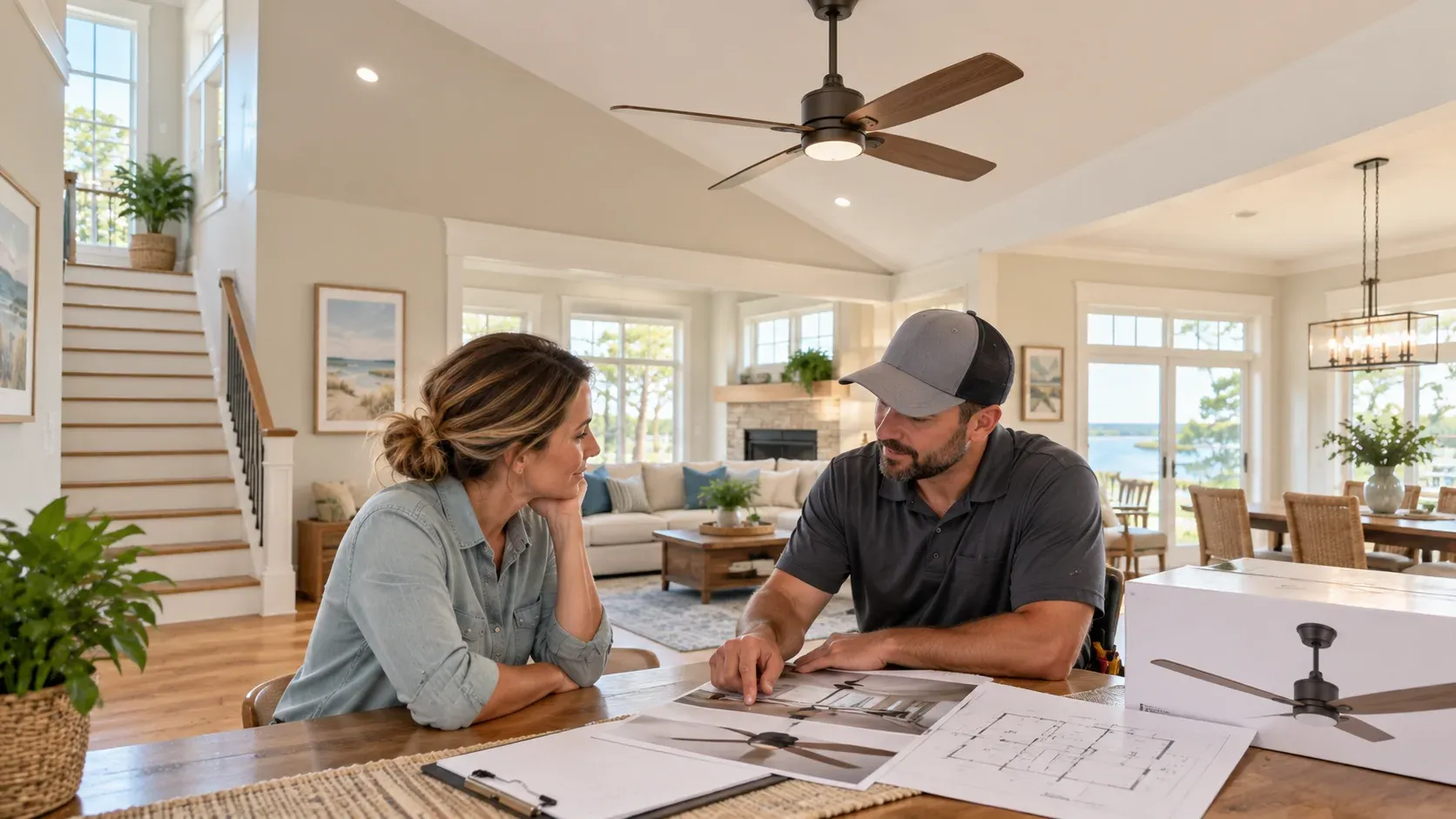

Ceiling fan installation at an existing light fixture may look like a simple swap, but the old opening does not prove the ceiling can support a moving fan. Coastal Comfort Electric’s ceiling fan installation service helps Wilmington-area homeowners verify the electrical box, structural support, wiring, controls, ceiling condition, and selected fan before installation.
A light fixture places mostly static weight on its support. A ceiling fan adds weight, rotation, vibration, and starting forces. The support has to be specifically suitable for that use.
The Existing Box Must Be Fan-Rated
The ENERGY STAR ceiling-fan installation guidance explains that a fan needs a listed fan-rated outlet box and secure structural support. Many boxes installed only for lights were never designed for a fan’s weight and movement.
A qualified installer may need to determine:
- Whether the box is identified for fan support.
- How the box or bracket attaches to framing.
- Whether the attachment is sound and accessible.
- The weight limit of the support system.
- Whether prior movement, water damage, or repairs affected the ceiling.
- Whether the selected fan requires a particular mounting system.
The answer cannot be established by the box’s shape alone. Labels, attachment, condition, and the fan instructions all matter.
Structural Support May Need To Change
When the existing box is not fan-rated, the project may require a listed fan-support brace, a box attached to framing, or another manufacturer-approved support method. Access from an attic can change the work, but lack of attic access does not automatically make the project impossible. It can affect the installation method, ceiling opening, labor, and restoration needs.
High, sloped, vaulted, plaster, decorative, or previously repaired ceilings deserve extra planning. A fan mounted to a sloped ceiling may need a compatible canopy and downrod arrangement. Heavy or oversized fans may have support requirements beyond a typical model.
Existing Wiring Does Not Guarantee The Controls You Want
An existing light location confirms that some wiring reaches the box, but it does not establish the wiring configuration, circuit condition, grounding, box fill, switching, or control compatibility.
Before installation, decide how you want to operate the fan:
- One wall switch with pull-chain controls.
- Separate wall control for fan and light.
- A compatible fan control or dimmer arrangement.
- A listed remote receiver supplied with the fan.
- Smart controls that are documented as compatible with the fan and light.
A standard light dimmer should not be assumed suitable for a fan motor. Remote receivers also need space, correct connections, and compatibility with the selected fan. If separate wall control is desired, the existing cable may not contain the needed conductors.
The Fan And Room Conditions Matter
Share the exact fan model before the appointment when possible. The instructions identify weight, mounting components, downrod options, control requirements, clearances, and environmental rating.
The room also affects the decision:
- Indoor dry room: A standard indoor-rated fan may be appropriate when the manufacturer allows it.
- Covered porch or humid area: Damp-rated equipment may be needed.
- Area exposed to rain or direct water: Wet-rated equipment may be required.
- Low ceiling: A compatible low-profile mounting system may be necessary.
- High or sloped ceiling: Downrod length, slope compatibility, access equipment, and blade clearance need review.
Do not rely on appearance or marketing language alone. Use the product listing and current installation instructions for the actual location.
Warning Signs At The Existing Fixture
Tell the electrician before installation if the light fixture, box, or ceiling has any of these conditions:
- The fixture moves, sags, or sits away from the ceiling.
- The ceiling is cracked, stained, soft, or recently repaired.
- The light flickers, trips a breaker, buzzes, or behaves inconsistently.
- The switch or fixture becomes warm or smells unusual.
- The location has had a roof leak or plumbing leak.
- Prior work added spacers, unsupported extensions, or an oversized cover.
Those clues may change the project from a straightforward installation to support repair, wiring diagnosis, ceiling coordination, or a new location.
What An Electrician Verifies Before Installation
Can The Light Usually Be Replaced With A Fan?
Often, yes—but “same location” does not always mean “same support and wiring.” Some homes already have fan-rated boxes and suitable controls. Others need a support upgrade, wiring change, different fan, or a revised installation plan.
A useful estimate states what has been confirmed and what remains conditional on access or inspection. Send safe photos of the room and existing fixture, the fan model, ceiling height, and your preferred controls. That gives the installer a better starting point without asking you to open the box yourself.