
Level 1 charging typically adds about 2 to 5 miles of driving range per hour, while Level 2 commonly adds about 10 to 30 miles per hour, according to current ENERGY STAR home-charging guidance. That difference is meaningful, but it does not mean every Wilmington homeowner should automatically buy the highest-powered charger available. The right setup depends on how far you drive, how long the vehicle remains parked, what the vehicle can accept, and what your home’s electrical system can support. Coastal Comfort Electric’s EV charger installation service can help turn those details into a practical home-charging plan.
This guide compares Level 1 and Level 2 EV charging without treating “faster” as the only goal. The better question is: which setup reliably replaces the miles you normally use before you need the car again?
Residential focus: This article is about charging at single-family homes. Apartment, multifamily, restaurant, office, retail, and other business installations involve different capacity, parking, accessibility, networking, and permitting decisions. Coastal Comfort Electric also provides commercial EV charger installation for Wilmington-area properties.
What Is The Difference Between Level 1 And Level 2 EV Charging?
Level 1 and Level 2 describe the electrical supply used by the charging equipment.
| Home charging option | Electrical supply | Typical range added per hour | Often fits drivers who… |
|---|---|---|---|
| Level 1 | 120 volts | About 2–5 miles | Drive relatively few miles, own a plug-in hybrid, or can leave the vehicle parked for long periods |
| Level 2 | 208–240 volts | About 10–30 miles | Drive farther, have an irregular schedule, share charging between vehicles, or want faster overnight recovery |
Actual charging speed varies with the vehicle, charging equipment, circuit capacity, battery temperature, state of charge, and other conditions. The car and charging equipment communicate, and the vehicle will not necessarily accept the charger’s maximum advertised output.
The U.S. Department of Energy’s Alternative Fuels Data Center notes that many drivers can meet their normal daily needs with overnight Level 1 charging. Level 2 becomes more useful for longer commutes, larger batteries, less predictable schedules, and vehicles that need more energy than Level 1 can restore during the usual parking window.
When Level 1 Charging May Be Enough
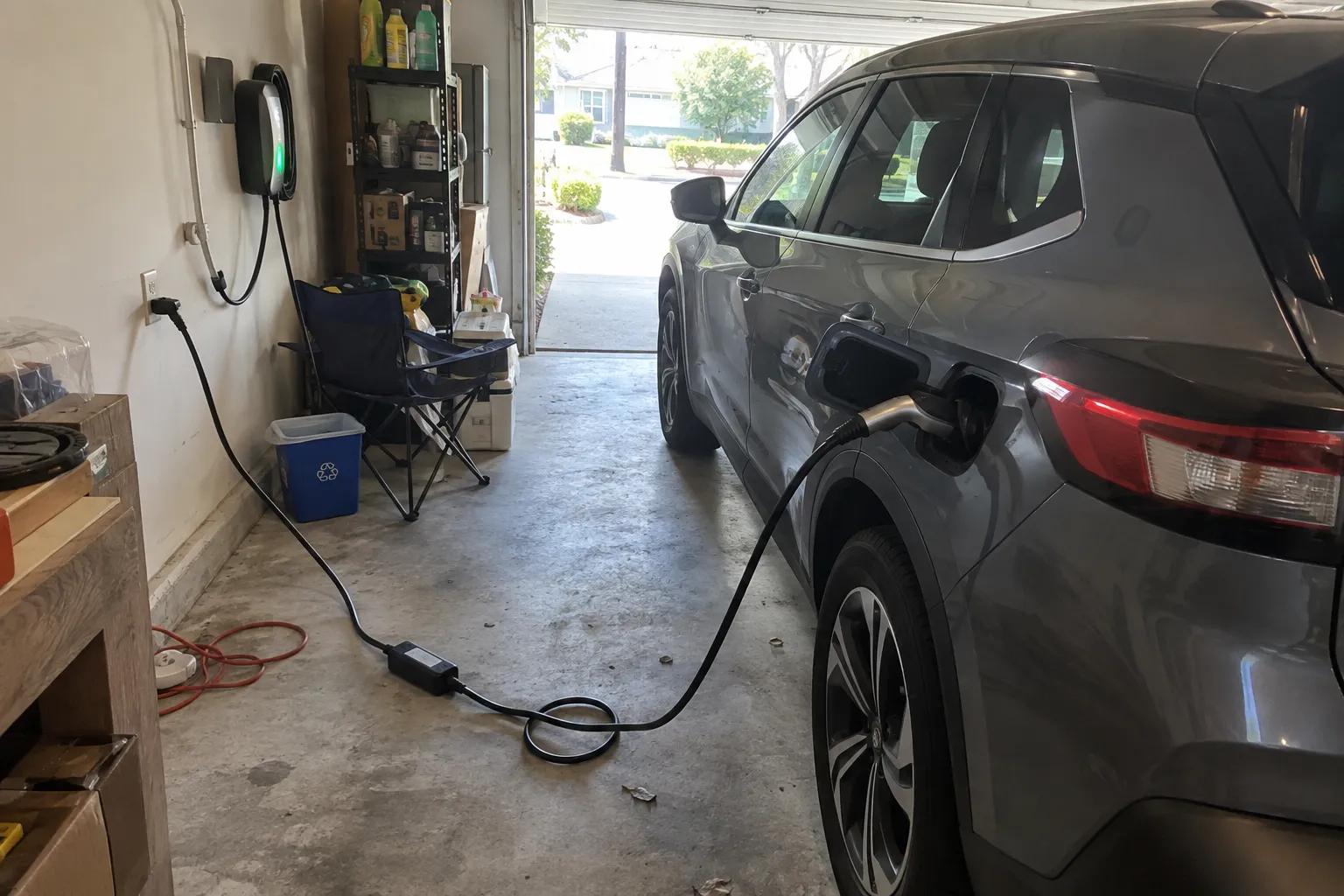
Level 1 charging uses a standard 120-volt supply. It may be a sensible solution when:
- You drive a plug-in hybrid with a relatively small battery.
- Your daily driving is limited and the vehicle is parked most evenings.
- You can recover the miles you use without beginning each morning at an uncomfortable state of charge.
- You have access to a suitable receptacle on an appropriate circuit near the parking space.
- Public or workplace charging can cover occasional high-mileage days.
“Standard outlet” should not be confused with “any outlet that happens to be nearby.” The receptacle, circuit condition, grounding, weather exposure, extension-cord use, and other connected loads all matter. A garage receptacle that already serves tools, a freezer, or other equipment should not automatically be assumed ready for hours of continuous vehicle charging.
Level 1 can be the economical answer for the right driver. It is not an inferior choice when it consistently supports the way the vehicle is used.
When Level 2 Charging Makes More Sense
Level 2 charging uses a dedicated 208- or 240-volt circuit and substantially reduces the time needed to recover driving range. It is often the better fit when:
- Your commute or daily driving regularly uses more range than Level 1 restores overnight.
- Your vehicle has a larger battery and spends fewer hours parked at home.
- Work, school, caregiving, or travel makes the next departure time unpredictable.
- Two vehicles may eventually share the charging location.
- You want charging to occur within a shorter off-peak electricity window.
- You are already remodeling, building a garage, or opening walls where EV-ready wiring can be planned efficiently.
Level 2 does not describe one fixed charging speed. Charging equipment can be configured at different current levels, and a modest Level 2 installation may meet a household’s needs without pursuing the highest possible output.
Plug-In Or Hardwired Level 2 Charger?
A Level 2 charger can sometimes plug into a properly installed 240-volt receptacle, or it can be permanently hardwired. Each approach has tradeoffs.
Plug-in charging equipment
A plug-in unit can be easier to replace or take with you when moving. The receptacle, circuit, enclosure, grounding, mounting, and equipment must still be appropriate for sustained EV charging. A receptacle that resembles the right configuration is not proof that its wiring and circuit are suitable.
Hardwired charging equipment
Hardwiring eliminates the plug-and-receptacle connection and is commonly used for higher-output equipment or outdoor installations. The EPA’s home-charging guide explains that chargers rated at 48 amps or higher are generally hardwired. The best choice still depends on the charger, circuit, installation location, manufacturer instructions, and applicable code requirements.
What Determines The Right Level 2 Charging Speed?
Buying a charger by its largest advertised amperage can create an unnecessarily complicated project. Start with the household’s actual charging requirement.
Daily driving
Estimate the miles driven on an ordinary day, then consider the occasional heavier day. A homeowner who drives 25 miles most days has a different need from someone who regularly returns home after a 120-mile trip and leaves again early the next morning.
Time parked at home
Ten hours of predictable overnight parking creates more flexibility than a vehicle that is home for only four or five hours. Smart scheduling may also be useful where the utility offers time-based electricity rates.
The vehicle’s onboard charging limit
The vehicle determines how much AC charging power it can accept. Installing charging equipment with a higher rating than the car can use will not make that car charge faster, although future vehicles may influence the decision.
Available electrical capacity
The desired charger output affects circuit size and the load added to the home. The EPA gives a common example: a 40-amp Level 2 charger requires a dedicated 50-amp circuit because EV charging is treated as a continuous load. An electrician should evaluate the home rather than selecting a breaker from the charger name alone.
Future plans
Consider a second EV, an electric water heater or range, a heat pump, a workshop, a hot tub, or an addition. Planning the charging circuit in the context of other expected loads can prevent avoidable rework.
Where Should A Home EV Charger Be Installed?
The best location balances everyday convenience with the electrical route. A useful site review considers:
- where the vehicle normally parks and the location of its charging port
- cable reach without creating a trip or driving hazard
- distance and access between the charger and electrical panel
- garage walls, finished rooms, attics, crawlspaces, masonry, or trenching along the route
- rain, flooding exposure, sunlight, salt air, and equipment weather ratings
- protection from vehicles, lawn equipment, and physical damage
- the possibility of a second vehicle or a different parking arrangement later
Outdoor home charging can be safe when the equipment and installation are designed for the location. DOE guidance specifically notes that outdoor installations require outdoor-rated equipment. Coastal conditions make equipment selection, mounting, sealing, drainage, and corrosion exposure worth discussing before a charger is purchased.
What Does A Level 2 EV Charger Installation Usually Involve?
A typical residential project may include:
- Confirming the vehicle, charger specifications, desired charging rate, and parking location.
- Reviewing the electrical service, panel, available capacity, breaker space, and existing major loads.
- Planning the conductor and conduit route from the electrical equipment to the charger location.
- Determining whether the equipment will be hardwired or receptacle-connected.
- Confirming outdoor ratings, mounting, cable reach, and protection where applicable.
- Handling the required electrical work, labeling, testing, and inspection steps for the approved scope.
- Showing the customer the disconnecting, charging, and scheduling features relevant to the installed equipment.
New Hanover County’s current EV-charging permitting guidance states that most chargers require an electrical permit. Its residential checklist may require the charger location, load information, circuit details, equipment documentation, and any related panel scope. Requirements can vary with the property and project.
What Should You Know Before Requesting An EV Charger Estimate?
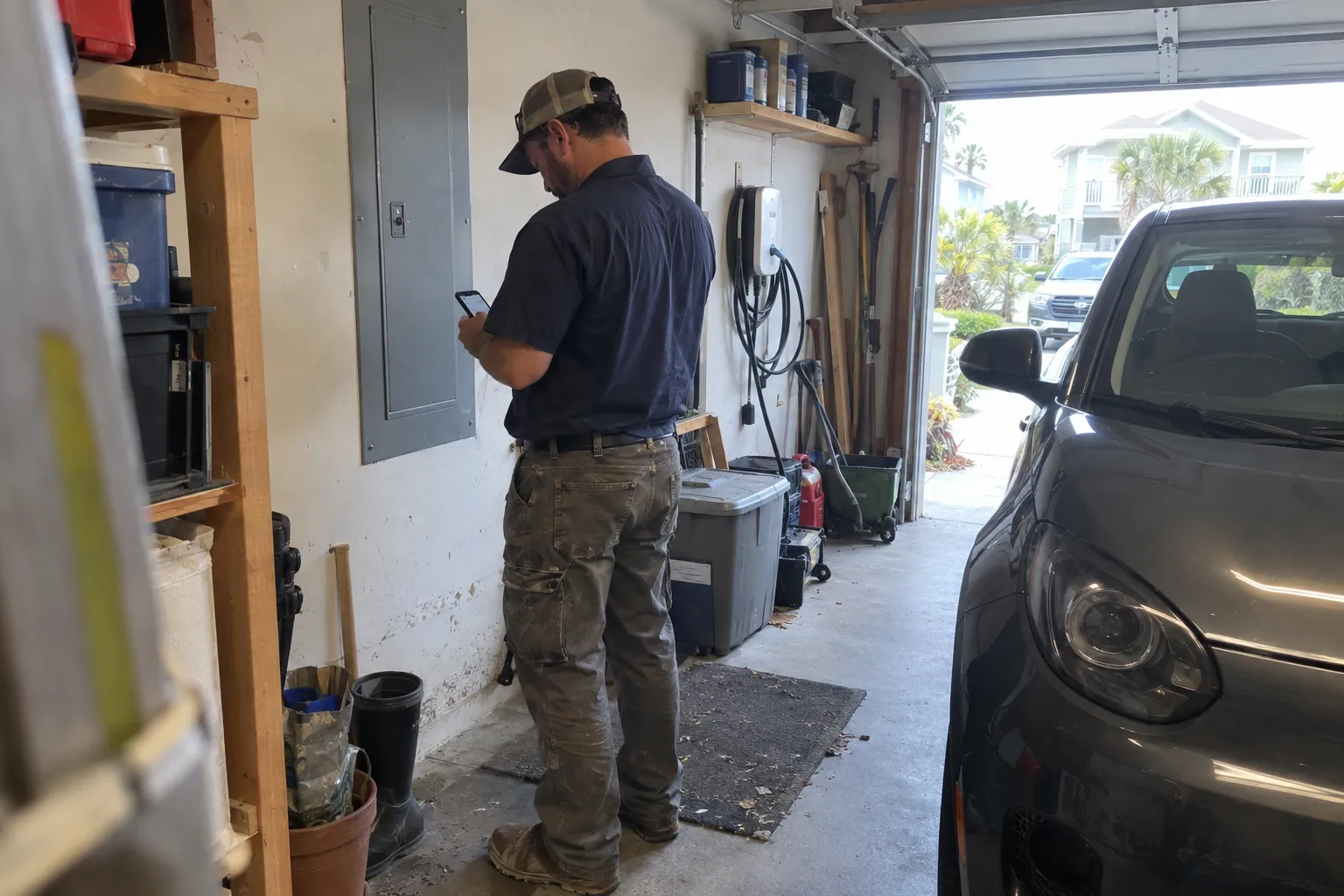
Do not remove an electrical panel cover or open energized equipment to collect information. Photos taken safely from outside the equipment, together with the charger model and parking layout, are a more useful starting point.
Level 1 vs. Level 2 EV Charging FAQs
Is Level 2 charging always better than Level 1?
No. Level 2 is faster, but Level 1 may cover the daily driving needs of a plug-in hybrid or a low-mileage driver. The right choice is the one that restores the range you use within the time the vehicle is normally parked.
Can I plug an EV charger into an existing dryer outlet?
Do not assume an existing receptacle is suitable because the plug appears compatible. Circuit rating, wiring, receptacle condition, other connected equipment, charger instructions, and the intended continuous load all require review. Sharing a circuit through approved load-management equipment may be possible in some situations, but it is a property-specific electrical decision.
Does every Level 2 charger require a panel upgrade?
No. Many homes can support Level 2 charging without replacing the panel or increasing service capacity. The decision depends on the home’s calculated electrical load, service rating, breaker space, charger current, and other existing or planned loads.
Can a Level 2 charger be installed outside?
Yes, when the charger and installation method are rated and planned for outdoor exposure. The location should also account for cable management, physical protection, drainage, mounting, and coastal weather conditions.
Should I buy the charger before calling an electrician?
You can research equipment first, but an electrical review before purchase may prevent a mismatch between the charger, vehicle, desired speed, location, and home capacity. Manufacturer documentation is useful during the estimate.
Choose Home Charging Around Your Real Routine
The best home EV charger is not necessarily the fastest model on the shelf. It is the setup that safely replaces your normal driving range, works where the vehicle is actually parked, fits the home’s electrical system, and leaves a sensible path for future needs.
If you are comparing Level 1 and Level 2 EV charging in Wilmington, Leland, New Hanover County, or a nearby Cape Fear community, Coastal Comfort Electric can review the vehicle, charging equipment, parking location, and electrical conditions behind the decision. Start with the EV charger installation service or use the request form to ask an electrician what information would be helpful for your property.